
5 Mistakes to Avoid With Driveway & Pavers
The most common paver regret we hear from Oakland homeowners isn’t about the pavers themselves. It’s “I should have asked to see the base before they covered it up.” The five costliest mistakes in a driveway or paver project are process failures – skipped inspections, wrong load ratings, missing edge restraint specs, unpermitted work, and handshake warranties – and none of them can be fixed by buying better stone after the fact. Get the process right and the pavers will last. Get it wrong and even premium materials fail within a few seasons. If you’d rather not gamble on the process yourself, call (833) 997-7759 for a free estimate.
Key Takeaways
- Ask to see the compacted base before any sand or pavers go down. It’s the highest-leverage five minutes of the whole job.
- Pedestrian-rated pavers in a driveway fail fast. Vehicles need vehicular-rated product, full stop.
- No edge restraint spec in the quote means no edge restraint. That omission alone causes more Oakland driveway failures than any other single factor.
- Permits and written warranty terms protect you at resale. Handshake promises don’t survive a home inspection.
Why does watching the base installation matter more than the finished product?
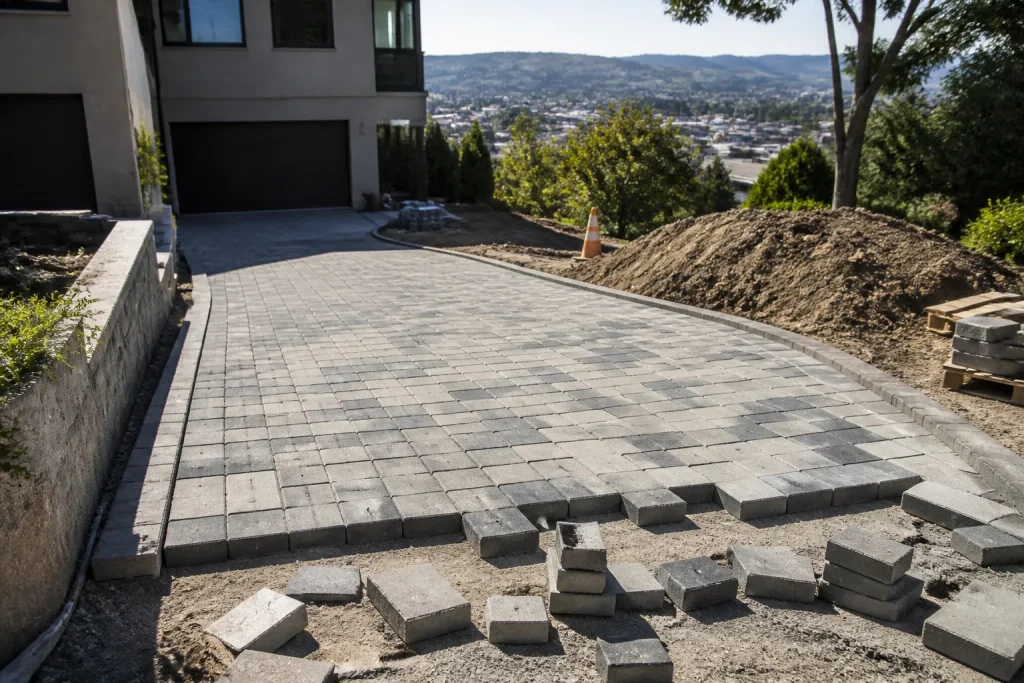
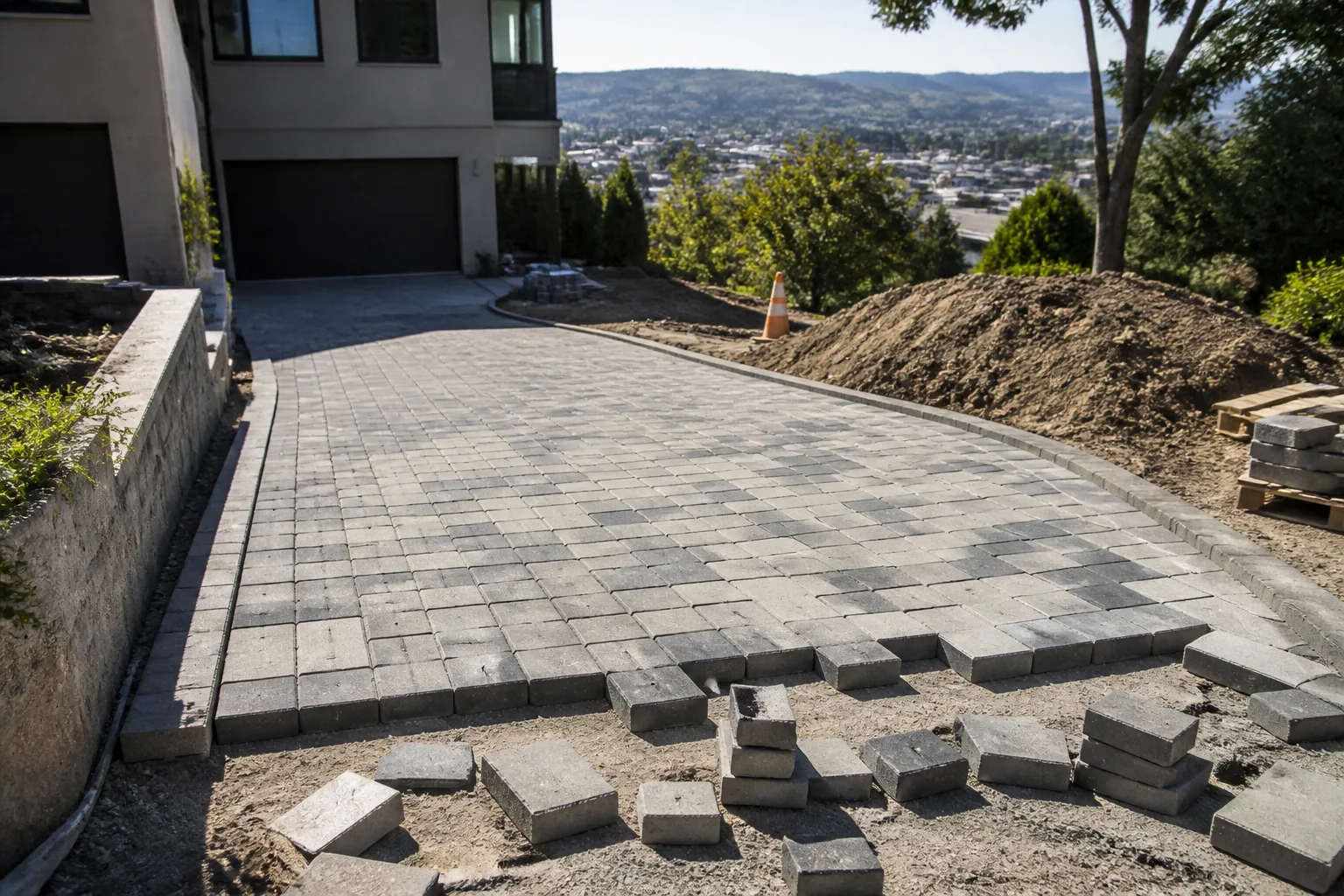
Because you can’t see the base once it’s covered, and that’s exactly when problems hide. In our experience, a paver surface is only as good as the 6 to 12 inches of compacted aggregate base beneath it. In Oakland, we regularly see spring and winter failures on older driveways where water pooled because the base wasn’t graded to drain, or where the aggregate wasn’t compacted in lifts. The pavers looked perfect for two years, then started heaving in the wet season.
What to actually check before the crew starts laying:
- Excavation depth. Base plus bedding sand plus paver thickness should match the spec, typically 8 to 12 inches total depending on soil and traffic.
- Compaction in lifts. Base should go down in 2 to 4 inch layers and be compacted each time, not dumped in one thick pile.
- Slope and drainage. Water should run off, not sit. In the Oakland flats around Fruitvale and East Oakland, poor drainage into a low spot is a recurring cause of settlement.
- The geotextile layer. A separation fabric over native soil stops fines from pumping up into the base. Skip it and the base weakens over time.
Ask for photos or a walk-through at the base stage. A contractor who’s confident in the work won’t mind. One who gets defensive about it just told you something useful.
Do you really need different pavers for a driveway than a patio?
Yes, and this is where looks-first shopping gets expensive. Pavers carry a load rating, and pedestrian-rated product is not built for vehicles. A driveway needs vehicular-rated pavers, typically specified to handle the compressive loads of cars and trucks, not foot traffic. Put pedestrian pavers in a driveway and they can crack, chip, or spall within a few years, especially where a heavy vehicle parks in the same spot day after day.
We pulled a set out of a garage over in the Dimond District last month where the homeowner had picked a beautiful thin pedestrian paver because it matched the patio. Two seasons of a full-size SUV later, the wheel tracks were cracking. The stone was fine. The spec was wrong.
What to confirm before you buy:
- Vehicular-rated designation from the manufacturer, stated in writing.
- Thickness appropriate for driveways – typically 2⅜ inches or more for vehicular use.
- Compressive strength rated for vehicle loads, not just foot traffic.
- Freeze-thaw and wet-dry performance if the product is going to see Oakland’s rainy season.
Brands like Belgard and comparable hardscape lines publish these specs. Read them instead of picking by color. The pavers should be built to last, backed in writing – not just look good in a photo.
Why does a missing edge restraint spec cause so many Oakland driveway failures?
Because without edge restraint, pavers spread. It’s the single most common cause of paver driveway failure in Oakland, and it almost always traces back to a quote that never specified it. Edge restraint – a rigid border, usually concrete or a pinned plastic or metal edge – locks the field in place. Remove it and the pavers creep outward under traffic, the joints open up, sand washes out, and the whole surface starts to shift.
Check your quote for the word “edge” before you sign. A vague line like “paver installation” doesn’t tell you whether restraint is included. If it’s not spelled out, assume it’s not in the price.
What a proper quote should specify:
- Edge restraint type – concrete curb, pinned plastic edge, or metal edging – and where it goes.
- Bedding method for the edge, since it has to be locked, not just laid.
- Polymeric sand for joint stabilization, which holds the surface together between restraint points.
- Drainage plan at the driveway apron, so water leaves the surface instead of pooling against the house or garage.
Along the Oakland hills, where slopes are steeper, edge restraint and drainage become even more critical. A driveway on a grade without proper restraint is a driveway that’s already failing, it just hasn’t shown you yet.
Do you need a permit for a paver driveway in Oakland?
Sometimes, and it depends on the scope. New driveway construction, changes to the curb cut or apron, alterations to drainage that affect stormwater runoff, and work in the public right-of-way typically require review through Oakland’s permitting process. Repaving an existing driveway within the same footprint may not trigger a permit, but the rules depend on the specifics. The safe move is to ask before any digging starts, not after.
Why this matters more than most homeowners realize: unpermitted hardscape tends to surface during a home sale. A buyer’s inspector notes the new driveway, the seller’s disclosure asks about recent work, and the permit question comes up. At that point, the cost of getting it permitted retroactively, plus the stress of a stalled closing, is far higher than pulling the permit upfront ever was.
What to ask your contractor:
- “Will this project require a permit, and are you pulling it?” A yes with a plan is what you want to hear.
- “Who handles the inspection?” The contractor should.
- “Can I see the approved permit and final inspection sign-off?” Both should land in your hands before final payment.
At Groundwork, we pull the permits and pass the inspections as part of the job. It’s a difference you’ll appreciate the day you sell.
What should a written warranty actually say?
It should say, in writing, what’s covered, for how long, and who fixes it if something fails. A handshake promise is not a warranty. It’s a memory of a conversation. When a paver settles two years later and the contractor has moved on or gone quiet, that memory doesn’t help you.
What to look for in the warranty terms:
- Workmanship coverage stated in years, not vague language like “guaranteed for life.”
- Specific failures covered – settlement, edge failure, drainage, joint sand loss.
- The remedy. Repair, replace, or make it right – spelled out.
- Exclusions in plain language – and the ones that usually get buried, like vehicle damage or acts of nature.
- Transferability if you plan to sell the home within the coverage window.
Every Groundwork project is covered by the 730-Day Done Right Promise – if it’s not done right, we make it right. That’s 730 days of written accountability, which is one of the longest workmanship guarantees in the residential construction space. Ask any contractor you’re considering to put their warranty in the contract. If they won’t, that’s your answer.
When should you call a pro instead of going it alone?
Call a professional if the project involves a slope, drainage correction, a permit, or vehicular traffic. Those are the conditions where an amateur install fails fastest. A small patio on flat ground is one thing. A driveway in the Oakland hills, on grade, with a permit requirement, is another. The base, the edge restraint, and the grading are all working together, and each one has to be right.
If you’re planning pavers as part of a bigger project, we handle the full scope from foundation to finish line. Related services in Oakland: Driveway & Pavers in Oakland and Fence Installation in Oakland. If you’re adding on, see Home Additions & ADU in Oakland, and for the full range of what we do, visit our Groundwork Construction Co. of Oakland home.
Calls are answered by a live person, 24/7 – no voicemail black holes – and every technician arrives background-checked and in uniform. You’ll get upfront pricing with no surprises, plus a free project estimate and design consult, 0% financing for 18 months, and $1,000 off projects over $10,000.
The Bottom Line
The five mistakes that cost Oakland homeowners the most on driveway and paver projects have nothing to do with the stone. They’re process mistakes: not checking the base mid-project, choosing pedestrian pavers for a vehicular driveway, accepting a quote that never mentions edge restraint, skipping the permit, and signing without written warranty terms. Get those five right and your pavers will still look right in ten years. Get them wrong and no product upgrade will save the job.
Need help? Groundwork Construction Co. of Oakland offers free estimates and written line-item quotes – call (833) 997-7759. You’ll reach a live person, any hour of any day.
Frequently Asked Questions
Look for three early warning signs: pavers spreading at the edges, joint sand washing out on a regular basis, and low spots where water pools after rain. Any of those point to a base, edge restraint, or drainage failure. Call (833) 997-7759 for a free estimate on a repair – we’ll tell you what we find.
A properly installed paver driveway typically lasts 25 to 30 years or more, depending on traffic, base quality, and drainage. Failures within the first five years almost always trace to base or edge restraint problems, not the pavers themselves.
Vehicular-rated pavers are engineered and tested for the loads a car or truck puts on them; pedestrian-rated pavers are not. Using pedestrian pavers in a driveway causes cracking and spalling within a few years. The rating is in the manufacturer’s spec sheet, so ask to see it in writing.
Yes. When a permit is required for driveway or hardscape work in Oakland, we pull it and handle the inspection. Call (833) 997-7759 for a free estimate – we’ll tell you upfront whether your project needs a permit and what that involves.
Written by the team at Groundwork Construction Co. of Oakland.
Need Construction Help?
Call Groundwork Construction Co. of Oakland - licensed & insured, here with fast after-hours help in Oakland.
(833) 997-7759